
Written by Dimitrios Vrachatis, Specialist Cardiologist, PhD, National and Kapodistrian University of Athens.
What is transcatheter aortic valve implantation?
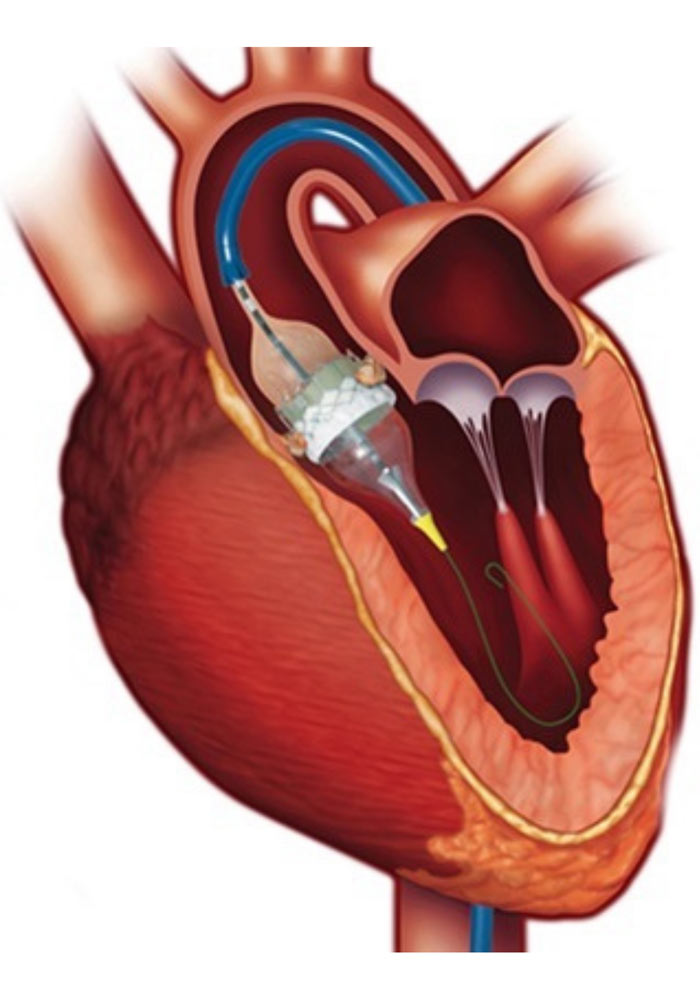
TAVI replaces a narrowed native aortic valve with an artificial biological valve without conventional open-heart surgery or opening the chest. In practice, the new valve is implanted within the old one.
The valve enters through a small incision in a peripheral artery, usually the femoral artery in the groin.
When is it needed?
The aortic valve connects the heart to the aorta, the body’s largest artery, which carries oxygenated blood to the organs. Severe stenosis means its opening has decreased from approximately 4 cm2 to less than 1 cm2. Symptoms such as angina or chest pain, fainting or heart failure are associated with poor life expectancy, approximately 2–5 years, and require treatment. Valve replacement restores estimated life expectancy towards the level expected without aortic stenosis.
Who can have TAVI instead of surgery?
Transcatheter aortic valve implantation (TAVI), also called transcatheter aortic valve replacement (TAVR), was first performed in 2002 and has since demonstrated safety and effectiveness in treating severe aortic stenosis.
It was initially a rescue option for very elderly patients unable to undergo conventional valve replacement, which requires opening the chest and is performed by a cardiac surgeon.
Extensive clinical studies over nearly two decades have supported its use in progressively younger patients with lower surgical risk.
Your cardiologist first establishes whether valve replacement is indicated. Individual characteristics then guide the choice between conventional surgery and TAVI.
How is it performed?
The interventional cardiologist introduces a biological valve through a peripheral artery, usually the femoral artery, and advances it into the narrowed native valve.
A specialised deployment system expands it to its full size, fixing it in position and compressing the structures of the original valve.
Is anaesthesia required?
Depending on the patient and the centre’s practice, TAVI can be performed with local anaesthesia and mild sedation.
Types of TAVI Valves
Early TAVI procedures prompted extensive research and development. Several models are now available from different manufacturers. Their leaflets are made from porcine or bovine pericardium, supported by a specialised metal-alloy frame.
They are classified as self-expanding or balloon-expandable, and differ in size and delivery systems.
This flexibility allows the cardiologist and Heart Team to choose the most suitable prosthesis after detailed assessment.
What preparation is needed?
Failing to plan is planning to fail. TAVI simplifies a major operation for the patient, but not for the medical team.
A successful, uncomplicated procedure requires extensive assessment, including:
- Echocardiography
- Coronary angiography
- CT angiography
These allow the Heart Team to confirm:
- Whether intervention is indicated
- Anatomical suitability
- The procedural plan
The team must also decide:
- Whether coronary angioplasty is needed. Significant lesions in major branches are usually treated before TAVI.
- The access route, such as transfemoral, subclavian or transapical.
- The most suitable valve type and size.
When can I leave hospital?
After TAVI, patients remain in hospital for a few days, initially in a unit offering enhanced monitoring. Increasing experience has reduced the stay from approximately seven days in the early years to around 2–3 days in most centres when there are no complications.
What are the risks?
Minimally invasive does not mean simple. Although benefits substantially outweigh risks, TAVI is a major intervention. Potential complications include:
- Access-site complications: 2–30%
- Stroke: approximately 2–3%
- Need for a permanent pacemaker: 2–25%
- Worsening kidney function or acute kidney injury: approximately 5–6%
- Very rarely, an acute aortic syndrome or death during the procedure
Published international experience shows a trend towards lower rates of most complications over time.