
Written by Dimitrios Vrachatis, Specialist Cardiologist, PhD, National and Kapodistrian University of Athens.
What is coronary angioplasty?
Percutaneous coronary intervention (PCI), commonly called angioplasty, treats coronary artery disease by reopening a narrowed or completely blocked coronary artery. These arteries supply oxygenated blood to the heart muscle.
What is the difference between a balloon and a stent?
Technology has advanced considerably since angioplasty was introduced in the 1970s. Originally, a special balloon was inflated inside the artery, which is why the procedure is still often called “balloon treatment”.
The problem with balloon treatment alone, now termed plain old balloon angioplasty (POBA), was restenosis: the treated narrowing could return.
Metal scaffolds, called stents, were developed to support the treated area and address restenosis. A balloon delivers and expands the stent. Stent implantation therefore always involves balloon inflation, but balloon treatment does not always involve a stent.
Stents are now used in the vast majority of procedures. Modern drug-eluting stents (DES) have thinner struts and release medicines to prevent restenosis, unlike older bare-metal stents (BMS).
When is angioplasty performed?
PCI is a life-saving emergency treatment for acute myocardial infarction, known as primary PCI. Primary angioplasty programmes have substantially reduced deaths from heart attacks, both internationally and in Greece, and reduced subsequent heart failure.
It is also performed electively when angiography and invasive or non-invasive functional tests, such as stress echocardiography, a perfusion scan or an exercise test, indicate that a significant area of myocardium is at risk from coronary artery disease, or as a last option for treating angina.
For extensive disease, particularly in people with diabetes, or anatomy making angioplasty difficult or impossible, coronary artery bypass grafting (CABG) may be recommended because its balance of risk and benefit is more favourable.
How is it performed?
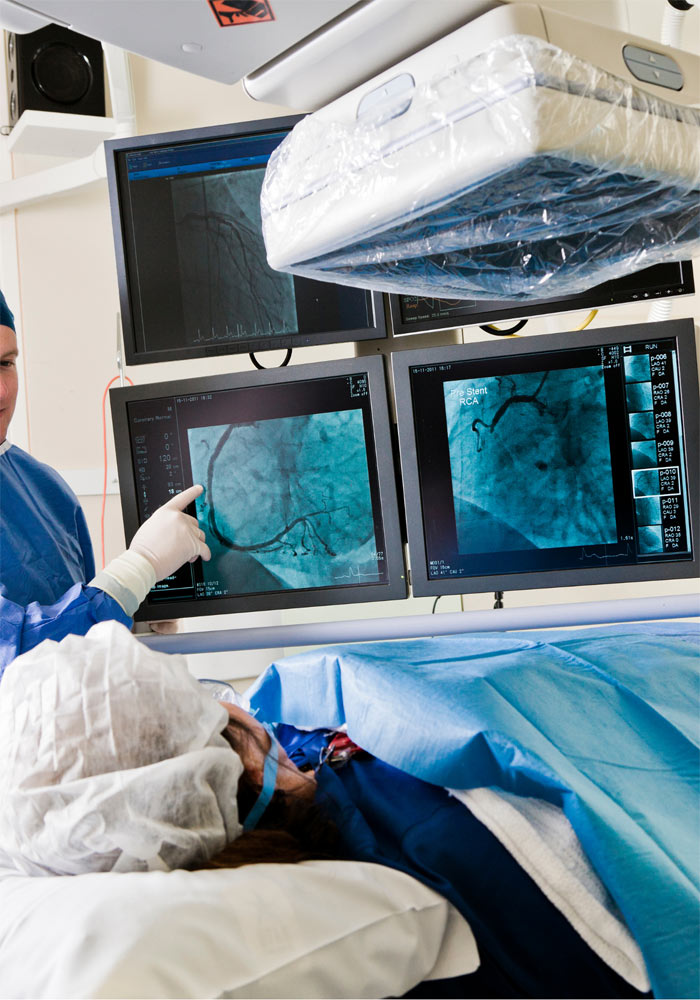
You lie on the catheterisation laboratory table. Clothing is removed and possible arterial access sites, usually the right wrist and groin, are shaved and cleaned. Local anaesthesia is given and a sheath inserted. Coronary angiography is always performed first.
The team decides which lesions to treat and how. Guidewires are advanced into the arteries. Balloon predilatation is usually performed, though it can be omitted in straightforward cases, followed by stent deployment. Complexity depends on the lesion’s location and each patient’s anatomical and functional characteristics.
Although angiography and angioplasty are different procedures, the main difference patients notice is the additional time.
Where is it performed?
In a specially equipped catheterisation laboratory with trained staff. Vital signs are monitored throughout, and any life-threatening complication can be treated immediately.
What should I do after receiving a stent?
Patients need a combination of antiplatelet medicines for an extended period. The exact regimen and duration balance the estimated risks of ischaemia and bleeding. These medicines must only be stopped after consulting the treating cardiologist or another cardiologist fully informed about the medical history.
Alongside dual antiplatelet therapy, which protects both the heart and the stent, intensive secondary prevention is essential: blood pressure control, substantial cholesterol reduction, glucose control, exercise, weight management where needed and permanent smoking cessation.
What are the risks?
Complications resemble those of angiography but are more frequent because equipment and treatment are applied within the coronary arteries. Minor complications usually involve vascular access or contrast, including allergy and usually reversible kidney impairment. Major complications include stroke, myocardial infarction or death, together occurring in fewer than 1% of elective cases.
When can I go home?
After elective angioplasty, discharge is usually the next day. Acute coronary syndromes, including heart attack or unstable angina, require more days of monitoring.
How does angioplasty differ from bypass surgery?
Both treat coronary artery disease invasively. An interventional cardiologist performs angioplasty using wires and catheters introduced through a peripheral artery. The patient is usually awake, and the procedure generally takes less than an hour except in complex cases. A cardiac surgeon performs CABG under general anaesthesia, opening the chest; it takes several hours.
The cardiologist considers:
- Angiographic findings
- Medical history
- The predicted technical success of each option
- The informed patient’s preference after discussing advantages and disadvantages
The central question is which method is expected to provide a longer and better life. The answer is not always clear-cut. Complex cases are discussed by a multidisciplinary Heart Team before a recommendation is made.