
Written by Dimitrios Vrachatis, Specialist Cardiologist, PhD, National and Kapodistrian University of Athens.
What is transcatheter closure of an atrial communication?
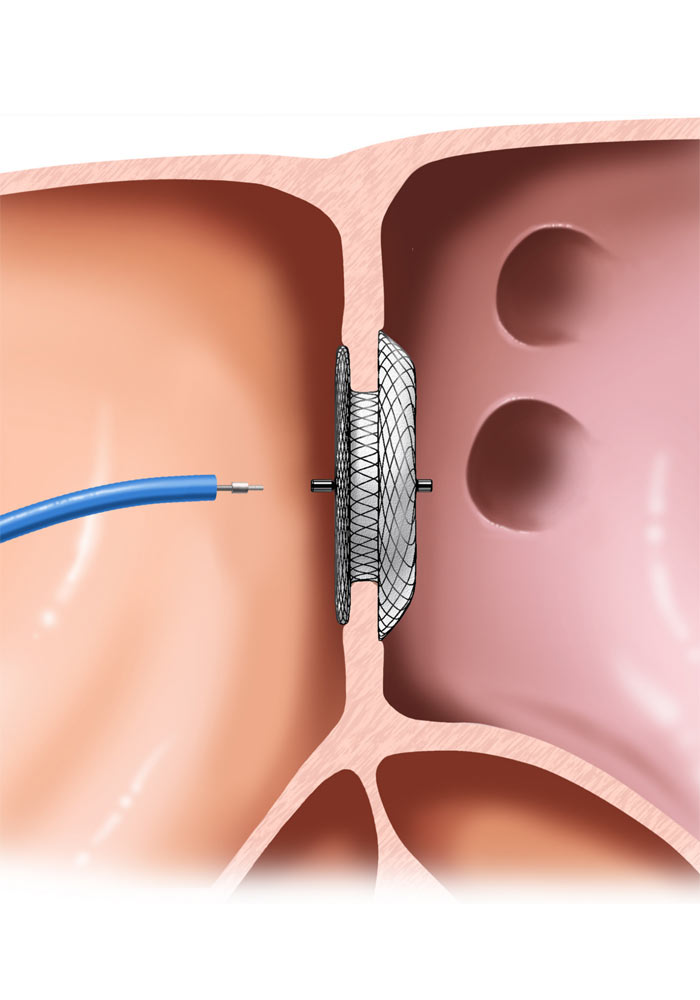
This procedure repairs a small opening (atrial septal defect, ASD) or a passage for blood flow (patent foramen ovale, PFO) between the left and right atria. An interventional cardiologist performs the repair using catheters through a minimally invasive approach. The alternative is open surgery performed by a cardiac surgeon.
How common are these communications?
An atrial septal defect is found in approximately 1 in 1,000 healthy people. A patent foramen ovale is found in between 1 in 3 and 1 in 4 healthy people. The foramen ovale is open in every fetus, but closes during the first months or years of life in most people.
Can leaving it untreated have consequences?
In most people, these communications are small and cause no problems. Problems arise when the blood flow through the communication is haemodynamically significant, changing the dimensions of the heart, or when paradoxical embolism occurs: an arterial blockage, such as a stroke, caused by an embolus originating in the right-sided heart chambers and passing through the abnormal communication.
How is it monitored?
Before and after the procedure, follow-up consists of clinical assessment and echocardiography.
Where is the procedure performed?
Transcatheter closure is performed in the catheterisation laboratory, which is equipped with a fluoroscopy system and suitable facilities for monitoring vital functions.
How is the procedure performed?
The interventional cardiologist punctures the femoral vein near the leg, inserts a sheath and advances the necessary equipment through the venous system to the right atrium.
The closure device, usually consisting of two discs, is advanced over special wires and released in the appropriate position using a dedicated mechanism.
The procedure is guided by fluoroscopy and echocardiography — either transoesophageal or intracardiac.
What is the success rate?
Reported closure success rates are approximately 100% immediately after the procedure, with complete closure in 93–96% of cases after one year.
What happens after the procedure?
The patient returns to their activities within 24–48 hours.
Are there risks or complications?
As with any invasive procedure, there are risks, although major adverse events are very rare. Risks include:
- Complications at the peripheral venous puncture site.
- Mechanical complications during implantation.
- Atrial arrhythmias (0.5–15%).
- Immediate or later thrombotic complications (1–2%).
- Pericardial effusion or tamponade (0.5–1%).
- Embolisation of the implanted device (0.9–1.3%).
The reported long-term risk of needing cardiac surgery or of death is less than 1 in 1,000 cases.