
Written by Dimitrios Vrachatis, Specialist Cardiologist, PhD, National and Kapodistrian University of Athens.
What is a pacemaker?
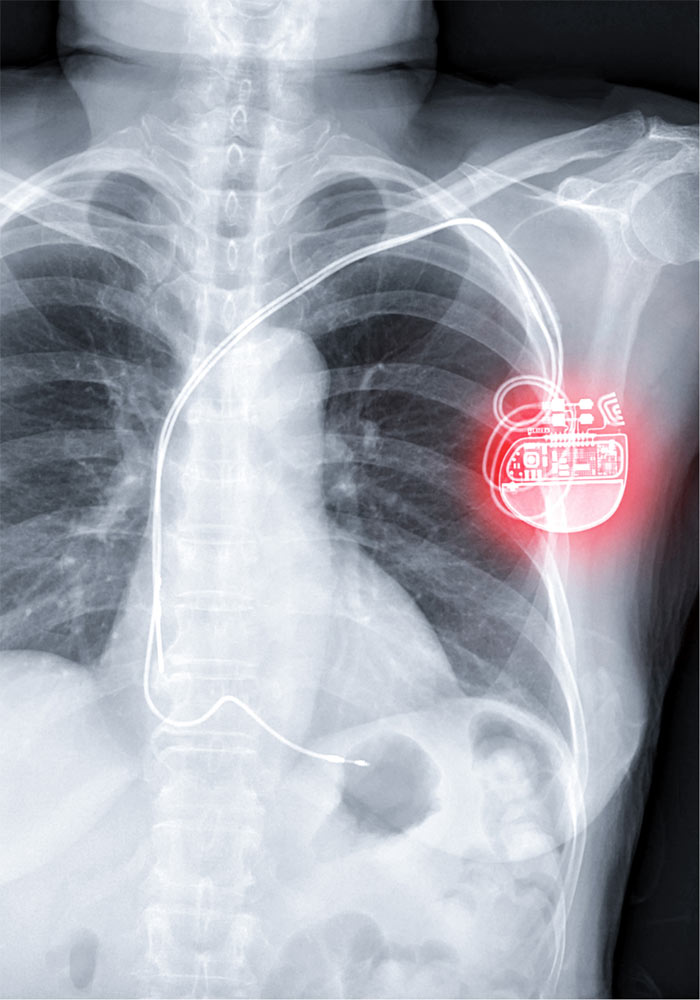
Pacemakers are implanted devices that support or fully replace the heart’s electrical conduction system when it is not working properly.
What is a pacemaker used for?
Each heartbeat follows an electrical impulse produced by the sinus node and transmitted in an organised way first through the atria and then the ventricles. Problems with this system can cause dizziness, temporary loss of consciousness or even sudden death. A pacemaker aims to prevent interruption of the heart’s electrical activity.
When do I need a pacemaker?
Permanent pacing is indicated for several slow heart rhythms, including atrioventricular block, sick sinus syndrome and tachycardia–bradycardia syndrome.
The strength of the indication varies, and decisions are individualised. Some indications are absolute and others relative. The greater the likelihood that the electrical system will fail and the heart will pause, the stronger the recommendation. The decision considers:
- Resting ECG findings
- Prolonged recordings, such as Holter monitoring or an implantable loop recorder
- Symptoms such as dizziness or fainting that can be causally linked to those recordings
- Potentially reversible causes
- The rest of the medical history
- Risks associated with the patient’s activities, such as professional driving
What are its components?
A conventional system has a generator and leads entering the right heart chambers and attaching to the myocardium. The generator is approximately matchbox-sized and weighs 20–50 grams. It contains the battery, electronics and lead connectors. Depending on need, there may be only a ventricular lead, or both atrial and ventricular leads.
How does it work?
The leads continuously detect the heart’s own electrical signals and relay them to the electronics in the generator. The device decides whether to deliver an impulse or allow the heart to continue without intervention.
This depends on its programmed minimum heart rate, usually 60 beats per minute.
Does it work continuously?
It monitors electrical activity 24 hours a day. When the heart’s own rate exceeds the programmed minimum, the pacemaker simply observes without delivering impulses.
What types are available?
Pacemakers are described by:
- Pacing: which chambers can receive artificial impulses.
- Sensing: which chambers’ electrical activity can be detected.
- Response to sensing: whether the device triggers pacing, inhibits pacing, does both or neither.
- Rate modulation: the ability to raise the pacing rate using sensors. This helps pacemaker-dependent people live more normally, for example by increasing their heart rate during exercise.
These functions are represented by a four- or five-letter code. Systems may also be classified by their leads:
- Single-chamber: one lead in the right atrium or ventricle.
- Dual-chamber: one atrial and one ventricular lead.
- Leadless: no leads.
- Biventricular pacing or cardiac resynchronisation therapy (CRT): an additional lead in the coronary sinus, the heart’s major vein, can pace the left ventricle. This treats selected patients with heart failure.
What is the pacemaker identification card?
It records key information, including model, lead type and number, MRI compatibility and patient details. You should carry it with you.
How is a pacemaker implanted?
Implantation usually takes place under local anaesthesia, sometimes with mild sedation, in a catheterisation or electrophysiology laboratory under strict sterile conditions.
After antiseptic preparation, a small incision is made below the collarbone. The left side is preferred in right-handed people. Venous access is usually obtained through the cephalic vein; if this is not possible, the subclavian vein is punctured.
The cardiologist advances the leads, uses fluoroscopy to guide their positions and verifies their function with electrical measurements using an external analyser.
The leads are connected to the generator, which is placed in a pocket between the skin and chest muscle, usually created after the initial incision. The skin is closed with sutures or clips.
What are the risks?
As with any invasive procedure, risks exist but are outweighed by the expected benefits. They include mechanical complications during implantation, such as fluid around the heart, pneumothorax or haemothorax, and infection of the pocket or leads. Risks are lower with cephalic rather than subclavian access and rise when implantation is more difficult. Promptly recognised complications can usually be treated effectively. Long-term infection, even elsewhere in the body, is a particular concern and needs timely treatment.
Can I return to normal life after discharge?
Discharge is usually the next day, with instructions for the initial recovery period. Movement of the arm on the implantation side is somewhat restricted at first.
Afterwards, normal life resumes, avoiding extremely strenuous activity with that arm. This is why the device is preferably placed on the non-dominant side: right for left-handed people and left for right-handed people.
When should I contact the doctor soon after discharge?
- Some incision or pocket pain is expected initially. Marked redness, swelling, severe pain or fever require immediate contact.
- A small haematoma may occur, depending on medicines affecting clotting. A larger haematoma or signs of inflammation require immediate contact.
- Strong, uncomfortable muscle contractions
- Severe or persistent breathlessness or chest pain
- Persistent palpitations
- Loss of consciousness or fainting
Do the stitches need removing?
This depends on the closure technique. Absorbable sutures need no removal. Non-absorbable sutures or metal clips are usually removed about a week after implantation.
How often should the pacemaker be checked?
Long-term checks are usually annual. An external programmer interrogates the device and provides information about battery life and lead properties.
Can I have an MRI?
Increasing numbers of pacemaker models are MRI-compatible. Details of the device and leads are recorded on the identification card.
What about airport checks and magnetic fields?
Avoid strong magnetic fields, such as those encountered during airport security checks, because they can temporarily alter device function or settings. Modern models have stronger electromagnetic shielding, reducing this risk. Phones with strong magnets, for example for wireless charging, should not be placed near the pocket.
How long does the battery last?
Modern pacemakers last approximately 7–8 years. As the battery approaches the end of its life, the doctor recommends generator replacement. This is simpler than initial implantation because the existing leads are reused.
What is a leadless pacemaker?
Leadless devices are approximately as long as the diameter of a small coin. Implantation is simpler: after puncture of the right or left femoral vein, the device is advanced and fixed directly into the right ventricular myocardium.
Besides easier implantation, the absence of leads avoids lead-related complications. These devices are therefore preferred in patients at increased risk of endocarditis. Once the battery expires, they cannot be removed; another leadless or a conventional pacemaker may then be implanted.