
Written by Dimitrios Vrachatis, Specialist Cardiologist, PhD, National and Kapodistrian University of Athens.
What is an exercise stress test?
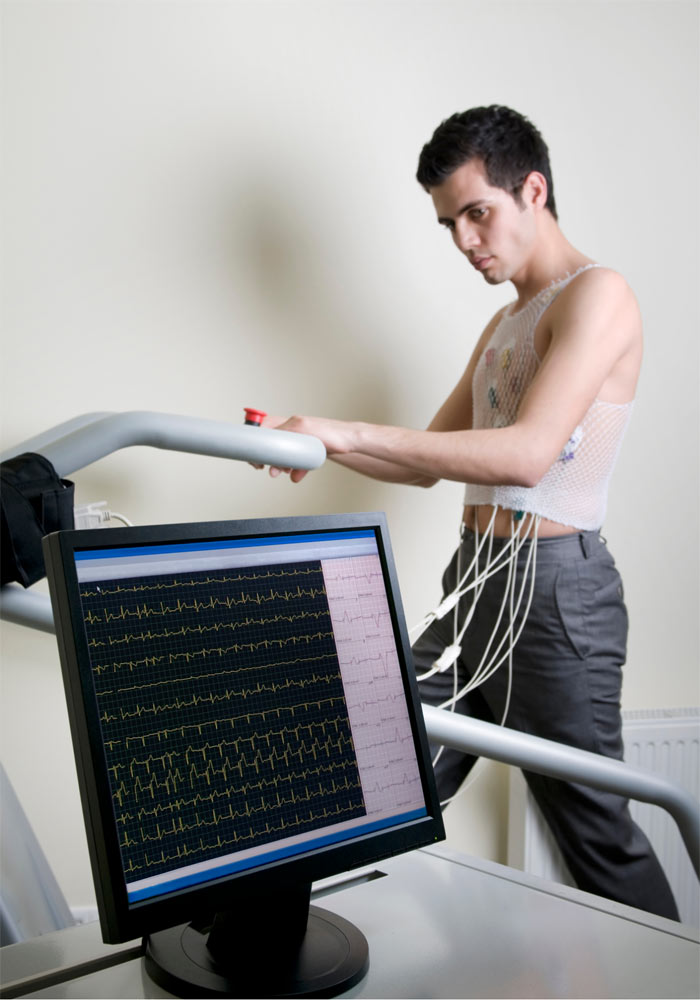
An exercise stress test continuously records an electrocardiogram while physical effort gradually increases according to a specific protocol, usually by brisk walking on a treadmill or using a stationary bicycle.
What does the cardiologist assess?
The cardiologist continuously watches the ECG for changes suggesting significant ischaemia, heart rhythm changes, the appearance, worsening or improvement of extra beats, and features such as pre-excitation.
Blood pressure is measured at intervals, and you are asked to report symptoms such as breathlessness or chest pain.
Monitoring continues for a few minutes after exercise. The whole examination takes approximately 20–25 minutes.
How does exercise affect the heart?
Exercise increases the heart’s oxygen requirements. Diseased coronary arteries may be unable to increase oxygenated blood supply adequately. The resulting relative ischaemia can produce ECG changes or symptoms.
A rising heart rate also changes certain electrical properties of cardiac cells and corresponding ECG features.
These mechanisms can reveal underlying problems.
Why is the test performed?
Reasons include:
- Confirming suspected coronary artery disease
- Assessing residual coronary disease after angioplasty or bypass surgery
- Estimating the risk of future adverse events
- Observing how existing arrhythmias or electrical features evolve during exercise
- Objectively assessing exercise tolerance or related symptoms
What happens during the test?
- ECG electrodes are attached to the front of the chest.
- A full ECG is recorded while lying down and standing.
- The exercise protocol starts, with difficulty increasing every three minutes.
- Monitoring continues for a few minutes after exercise finishes.
When is the test stopped?
The test is stopped whenever continuing would be unsafe, including:
- Severe muscle fatigue
- Marked dizziness or feeling faint
- Severe pain or breathlessness
- Dangerous arrhythmias
- Very high or very low blood pressure
- A positive criterion for ischaemia
Did I pass or fail the test?
A one-word answer to this common question is not meaningful. Results are interpreted using several findings, the reason the test was requested and the individual’s medical history.
How are the results interpreted?
The test assesses electrical activity during intense exercise. Its result depends on recognised ECG changes and any symptoms that develop.
Certain requirements must be met before a conclusion can be drawn, including reaching an age-specific heart rate. This threshold is 85% of the predicted maximum heart rate, calculated as 220 minus age.
A positive or negative test for ischaemia means that the method’s criteria support or exclude clinically significant coronary disease. The possibility of false-positive and false-negative results is always considered.
A non-diagnostic test means the conditions for a reliable conclusion were not met. It therefore cannot answer whether clinically significant coronary disease is present.
Which functional test should I choose?
Treadmill or bicycle testing requires a minimum level of fitness and no major musculoskeletal limitations, such as knee problems. Alternative functional tests are available when strenuous exercise is not possible.
The cited guidance gives greater priority to stress imaging, such as stress echocardiography or myocardial perfusion scintigraphy, for coronary disease diagnosis because of their higher diagnostic accuracy.
The final choice depends on individual circumstances and local availability.
Should I have a stress test without first seeing a doctor?
This is poor practice for several reasons:
- Interpretation can lead to unnecessary further tests and inconvenience.
- You may be unable to complete the test or may be injured, for example because of an orthopaedic problem.
- A contraindication may be present, which the cardiologist performing the test should check.
When is exercise testing contraindicated?
The test deliberately increases cardiac workload to reveal problems that remain silent at rest.
It is therefore contraindicated when acute disease is suspected, such as an acute coronary event, myocarditis or severe aortic stenosis.
It is also not useful when baseline ECG abnormalities prevent interpretation of the expected exercise-related changes.
Are there risks or complications?
The test is generally safe. Dangerous arrhythmias are reported in approximately five per 10,000 tests, and death in fewer than one per 10,000. It is therefore always performed under a cardiologist’s supervision.
How should I prepare?
Avoid a large amount of food or fluid for 2–3 hours beforehand. Wear comfortable shoes and clothing suitable for exercise.
Medicines such as beta-blockers usually need to be stopped 2–3 days beforehand, according to the instructions for your test.
Men with dense chest hair should shave the relevant area so that the electrodes remain securely attached.